Online Olai Chuvadi
What olai chuvadi means, in Tamil and in English
Olai chuvadi is Tamil for a manuscript written on palm leaf. For centuries, before paper became common across Tamil Nadu and the rest of South India, palm leaf was how people recorded and passed down knowledge.
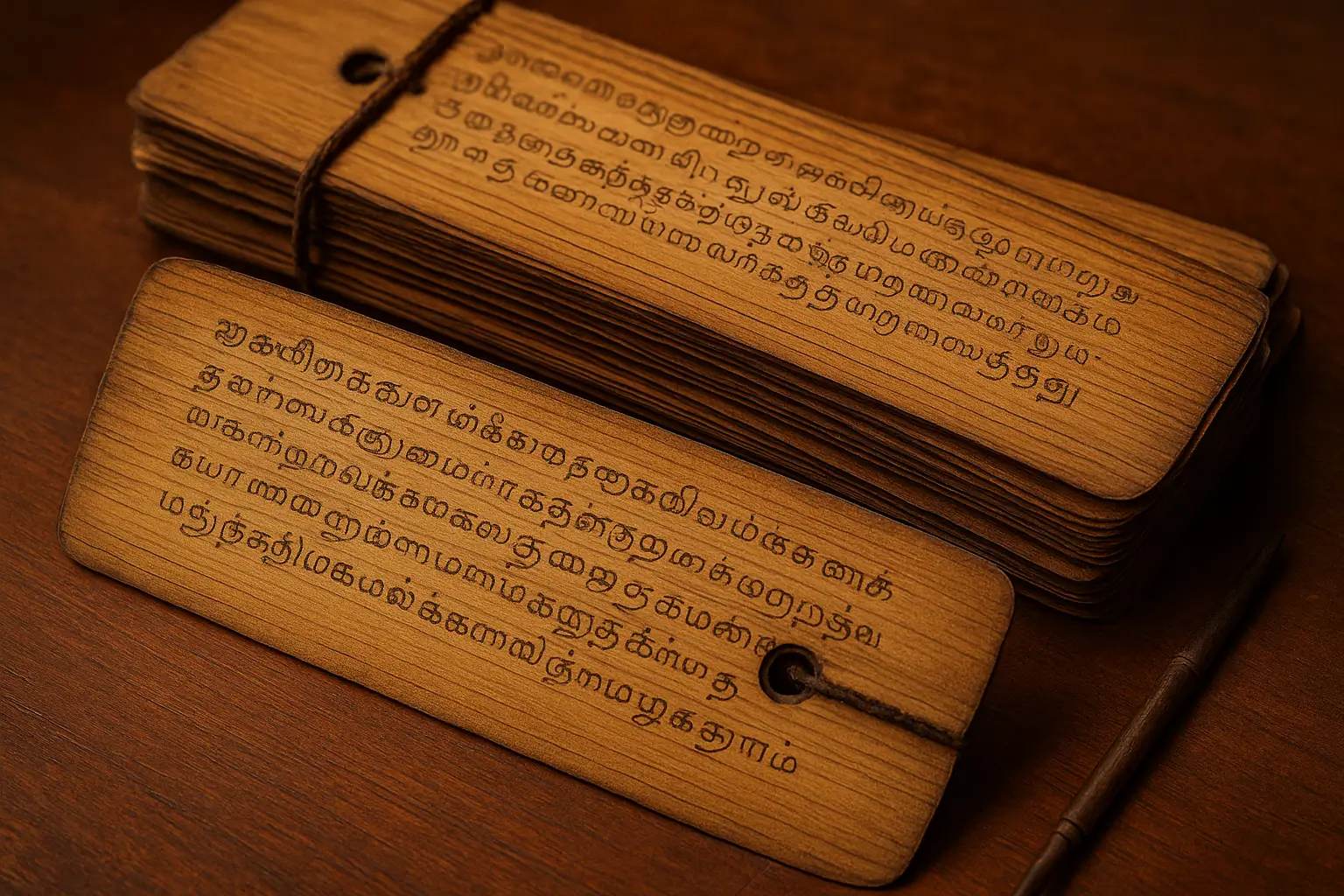
You’ll see the term spelled several ways online — Olai Chuvadi, Olai Suvadi, Olaichuvadi, Olaisuvadi. They’re all pointing at the same thing: the Tamil palm leaf manuscript tradition, just transliterated differently.
These manuscripts held more than one kind of knowledge. Literature, medicine, philosophy, religious teaching, traditional science, history, astrology — all of it got written on palm leaf at some point. So the meaning of olai chuvadi is wider than astrology alone, even though that’s often the reason people search for it.
Certain palm leaf manuscripts, within specific Nadi traditions, are tied to Nadi readings. But it helps to keep two things separate:
- Olai chuvadi is the palm leaf manuscript itself.
- Nadi astrology is the traditional practice of identifying and interpreting particular Nadi manuscripts.
This page covers what olai chuvadi means — in Tamil and English — how the manuscripts were made, and how the term relates to Nadi astrology.
How Olai Chuvadi Readings Work
1. Thumb Impression Classification
Your thumb impression is used to identify your Nadi category.
2. Palm Leaf Bundle Search
Readers locate your leaf from ancient palm leaf bundles.
3. Identity Confirmation
Matching questions verify the leaf belongs to you.
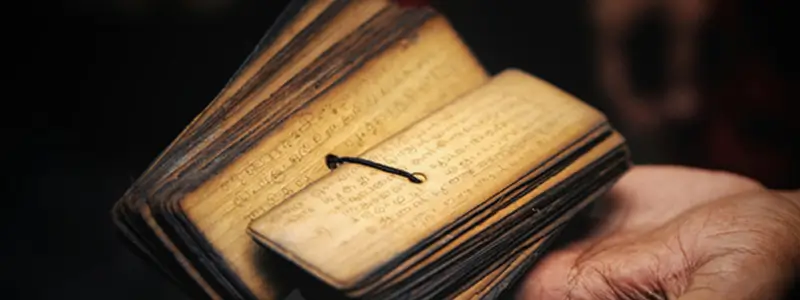
4. Detailed Life Reading
Your leaf reveals major life events and insights.
5. Life Guidance Overview
Guidance is given on career, family, marriage, and health.
6. Personalized Karmic Remedies
Specific remedies are suggested to overcome obstacles.
Agasthiya Nadi – The Foundation of Nadi Astrology
Agasthiya Nadi is considered the most revered and authoritative branch of Nadi Astrology. Sage Agasthiya, one of the greatest Tamil Siddhars, is believed to have documented detailed life records of countless souls.
Agasthiya Nadi readings provide deep insights into karmic patterns, past birth influences, and spiritual responsibilities. The guidance received through these leaves helps individuals align their actions with dharma and long-term well-being.
Sivinadi – Divine Guidance from Lord Shiva
Sivinadi, also known as Shiva Nadi, is regarded as one of the most spiritually powerful Nadi systems. These palm leaves are believed to contain divine messages conveyed through Lord Shiva.
Sivinadi readings are deeply spiritual in nature and focus on higher consciousness, soul evolution, and remedies that emphasize devotion, discipline, and inner transformation. Due to its depth, Sivinadi is interpreted only by highly experienced Nadi readers.
What does olai chuvadi mean?
The word comes from Tamil terms tied to palm leaf writing. In English, the simplest translation is palm leaf manuscript — a written record kept on a prepared palm leaf.
Before paper, leaves were prepared, written on, and bound together into collections. An olai chuvadi isn’t defined by one subject. Depending on which collection you’re looking at, it might hold:
- Tamil literature or poetry
- Siddha medicine
- Philosophy or religious teaching
- Temple or historical records
- Traditional science
- Astrology
Only some of these traditions connect to Nadi astrology — which matters if you’re trying to pin down what olai chuvadi actually means, rather than assuming it’s always about astrology.
Olai chuvadi in English
The closest English equivalent is palm leaf manuscript. You’ll also see it described as a palm leaf document, palm leaf record, or traditional manuscript — all pointing at the same physical tradition.
Breaking down the word
| Term | Meaning |
|---|---|
| Olai | Palm leaf |
| Chuvadi | Written record or manuscript |
| Olai Chuvadi | Palm leaf manuscript |
Depending on context, someone searching “olai chuvadi in English” might want the general meaning of the term, background on the manuscript tradition, or its connection to Nadi astrology. Related, but not interchangeable.
Olai chuvadi in Tamil
Written in Tamil, it’s ஒலைச்சுவடி. ஒலை (olai) means the palm leaf used as writing material; சுவடி (chuvadi) means a written record or manuscript. Put together, they describe a document created and kept on palm leaf.
Tamil Nadu’s connection to this tradition runs deep — it’s part of the region’s literary, medical, religious, and historical heritage. That’s why you’ll find people searching in both Tamil and English: ஒலைச்சுவடி, Olai Chuvadi, Olai Suvadi, Olaichuvadi, Olaisuvadi. The spelling shifts because Tamil sounds get transliterated into English letters in more than one way.
Olai chuvadi, olai suvadi, olaichuvadi — same thing?
Yes. These spellings all describe the same term and the same manuscript tradition. The difference comes down to how the Tamil sound gets written in English: some write it as “chuvadi,” others as “suvadi.” If you’re searching for one, you’re looking for the same information as someone searching the other.
This page sticks with “Olai Chuvadi” for consistency, while recognizing the other spellings mean the same thing.
What is an olai chuvadi manuscript, physically?
It’s a written record kept on a prepared palm leaf. Before paper took over, making one meant selecting suitable leaves, preparing and drying them, cutting them into strips, creating a surface to write on, inscribing the text, binding leaves into collections, and maintaining them over time.
Since palm leaf is a natural material, it needs careful handling to survive — and exactly how that was done varied by region, period, and tradition.
How were they written?
Rather than writing with ink on a surface, the traditional method involved inscribing letters directly into the leaf with a stylus. A darkening substance was then rubbed into the grooves so the writing stood out.
It’s a process that demands care — palm leaf damages easily in the wrong hands — but done properly, it preserved text for generations. What survives isn’t just the writing itself, but a whole system of preparing, inscribing, and maintaining these documents.
How were they preserved?
Palm leaf is organic, so it’s vulnerable — to humidity, heat, insects, mold, moisture, plain wear. Keeping a collection usable meant constant upkeep: leaves bound into bundles, stored and maintained however the custodians of that particular collection did it. Methods weren’t identical across every collection, but the underlying challenge was the same everywhere — without ongoing care, the manuscripts don’t last. That’s why any given collection is best understood in its own historical and custodial context, rather than as part of one uniform system.
Olai chuvadi is bigger than astrology
Palm leaf manuscripts held all kinds of traditional knowledge, not just astrology. Tamil literary works and other compositions were preserved this way. Siddha and related medical traditions have deep manuscript roots. Philosophical and religious teachings were recorded and passed down. Historical records and documentation found their way onto palm leaf too. And certain manuscript traditions — including some Nadi traditions — cover astrology.
Every Nadi manuscript is an olai chuvadi. Not every olai chuvadi is a Nadi manuscript. That’s really the whole distinction that gives the term its broader meaning.
Is olai chuvadi the same as Nadi astrology?
No — though the two are closely linked in certain traditions.
Olai chuvadi is the palm leaf manuscript, the written record itself, part of a broad manuscript culture. Nadi astrology is the traditional practice of identifying and interpreting specific manuscripts tied to Nadi readings.
| Olai chuvadi | Nadi astrology |
|---|---|
| Palm leaf manuscript | Traditional reading system |
| Written record | Identification and interpretation |
| Broad manuscript tradition | Specific astrology tradition |
| Can hold many subjects | Tied to particular Nadi manuscripts |
They shouldn’t be treated as synonyms. For more on the reading system itself, see the main Nadi astrology page.
How olai chuvadi connects to Nadi astrology
Specific manuscript collections are traditionally tied to Nadi readings, where verses within a collection are identified and interpreted for a particular seeker. Broadly, that process runs through initial identification — traditional methods, sometimes including thumb impression classification — followed by a search through the relevant bundles, a traditional confirmation to check whether a manuscript actually matches the seeker, and finally the interpretation once a match is found.
The olai chuvadi stays the manuscript throughout. The Nadi reading is everything that happens around identifying and interpreting it. For the full process, see Nadi astrology.
What is “olai chuvadi astrology”?
People search this phrase looking for the link between palm leaf manuscripts and Nadi astrology — but the phrase itself is a bit misleading. Olai chuvadi doesn’t automatically mean astrology; it means the manuscript. When a manuscript happens to connect to Nadi practice, you’ll see it described as Nadi astrology, palm leaf reading, Nadi manuscript reading, or Nadi consultation.
Put simply: olai chuvadi gives you the manuscript, Nadi astrology gives you the reading built around it.
How is olai chuvadi used in a Nadi reading?
Within a given Nadi practice, the practitioner works through relevant collections, searches the right bundles, runs traditional confirmation, identifies the verses, and interprets them. The exact steps shift depending on the tradition, the collection, the practitioner, the type of consultation, and the methods a given centre follows — so no two consultations look identical. Any centre worth consulting should walk you through their process before you book.
Olai chuvadi and Nadi chapters (Kandams)
If you’re researching Kandams, you’ll likely run into olai chuvadi along the way, since certain Nadi traditions organize readings into chapters. That’s a separate topic from this page, though — worth keeping distinct: olai chuvadi is about the manuscript, Kandams are about how readings are structured, and Nadi astrology is the reading system that ties both together.
For the chapters themselves, see the dedicated Nadi Astrology Chapters page.
Olai chuvadi and talapatra
Both terms point at palm leaf manuscripts, just from different linguistic roots. Olai chuvadi is Tamil terminology; talapatra comes from Sanskrit and shows up in a broader Indian context. Which term gets used often comes down to language, region, and which tradition you’re looking at. For more, see Talapatra Astrology.
Olai chuvadi in Tamil Nadu
Tamil Nadu’s ties to palm leaf manuscript culture run deep, across many kinds of traditional knowledge. Within Nadi astrology specifically, Vaitheeswaran Koil is well known for its association with Nadi reading practices.
But it’s worth remembering olai chuvadi isn’t just about one place or one kind of reading — it’s the wider tradition of preserving knowledge on palm leaf, of which Nadi manuscripts are one part.
Can you get an olai chuvadi reading online?
The manuscript itself stays a physical object in a collection somewhere — but the consultation around it doesn’t have to happen in person. Whether remote consultation is available depends on the practitioner, the centre, the type of reading, and the language you need.
Worth separating clearly: the manuscript is the physical olai chuvadi; the consultation is the communication between practitioner and seeker.
Before booking, ask the centre who’ll conduct the reading, how the process starts, what information they need, how they’ll communicate, what language is available, and what kind of reading they’re offering. For more, see Online Nadi Astrology.
What to check before booking a consultation
Know what you’re actually booking — general astrology, horoscope reading, Nadi astrology, and palm leaf reading aren’t interchangeable.
Ask who the practitioner is: which centre they’re with, what tradition they follow, how the consultation is arranged.
Get a clear sense of the process too — how it starts, how you’ll communicate, whether confirmation is part of it, how the reading gets explained.
And be wary of guaranteed claims. Nadi astrology and related palm leaf reading are traditional spiritual and astrological practices — interpretations and experiences vary from person to person. Nobody can honestly present this as a guaranteed prediction of the future.
About the Nadi practice at Sivayogi
Sivayogi offers information and consultations tied to traditional Nadi astrology and palm leaf reading, associated with Guruji Dr. A. Sivasamy, M.A., Ph.D., and connected to the Nadi tradition of Vaitheeswaran Koil, Tamil Nadu.
If you’re considering a consultation, the About and Nadi Astrologer pages have the practitioner background, process details, and contact information.
Why the distinction matters
Online, terms like olai chuvadi, palm leaf reading, Nadi leaf, Nadi astrology, and palm leaf astrology often get used as if they’re interchangeable. They’re not.
Roughly, it runs: palm leaf manuscript tradition → olai chuvadi → different kinds of knowledge → specific Nadi manuscript traditions → Nadi identification and reading → Nadi astrology consultation.
Knowing where you are in that chain tells you whether you’re researching a manuscript, Tamil terminology, palm leaf history, Nadi astrology, or an actual consultation. This page mostly covers the first two — olai chuvadi as a Tamil manuscript tradition, and how it connects to Nadi astrology.
Frequently asked questions
What does olai chuvadi mean? A Tamil term for a manuscript or written record kept on palm leaf.
What is olai chuvadi in English? Usually translated as palm leaf manuscript — also described as a palm leaf document or record.
What is olai chuvadi in Tamil? ஒலைச்சுவடி — a written record preserved on palm leaves.
Are olai chuvadi and olai suvadi the same? Yes, just different transliterations of the same Tamil term. Olaichuvadi and Olaisuvadi are the same again.
Is olai chuvadi the same as Nadi astrology? No. Olai chuvadi is the manuscript; Nadi astrology is the practice of identifying and interpreting specific Nadi manuscripts.
Are all olai chuvadi manuscripts about astrology? No — they’ve historically covered literature, medicine, philosophy, religion, science, and astrology. Only certain traditions tie into Nadi astrology specifically.
What is “olai chuvadi astrology”? A search term people use for the link between palm leaf manuscripts and Nadi astrology. The manuscript is the olai chuvadi; the reading practice is Nadi astrology.
How were olai chuvadi manuscripts written? Letters were inscribed into prepared palm leaves with a stylus, then a darkening substance was rubbed in to make the writing visible.
How were they preserved? Carefully, and continuously — palm leaf is organic and vulnerable to moisture, insects, heat, and mold.
What’s the difference between olai chuvadi and talapatra? Olai chuvadi is Tamil; talapatra is Sanskrit-derived and used more broadly across India.
Can olai chuvadi be used in Nadi astrology? Some manuscript traditions are tied to Nadi astrology — but not every olai chuvadi is a Nadi manuscript.
Can I get a Nadi consultation online? Some practitioners offer remote consultations — availability depends on the practitioner, centre, and tradition followed.